Product: Abaqus/Standard
Many of the elements in Abaqus allow centrifugal, Coriolis, and rotary acceleration forces to be included.
This section defines these load types.
It is assumed that the model (or that part of it to which these forces are applied) is described in a coordinate system that is rotating with an angular velocity,  , and/or an angular (rotary) acceleration,
  . Let
. Let  be a right-handed set of unit, orthogonal vectors that form a basis for this system. Then,
  and
and  .
.
If the angular velocity is cast as

 is the magnitude of and
  is the unit axis of rotation, the rotary acceleration is
 represents the effect of the motion of the axis of rotation (precessional motion);
 is the magnitude of the rotary acceleration; and
  is the axis of rotary acceleration. If
  , then
  and
and  . In component form

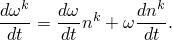
Let  be a point on the axis of rotation. The position of a material particle,
  , can be written

 ,
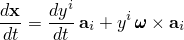
,  , are the coordinates of the point in the rotating basis system. Taking time derivatives,

We assume that the origin of the rotating system,  , is fixed, so that
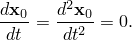
The virtual work contribution from the d'Alembert forces is

 is the mass density of the body in its reference configuration, where its volume is
  and
and  is a virtual variational field. For the part of the body described in the rotating system, the acceleration,
  , is given by Equation 6.1.1–1, while
  only, since and are prescribed and is fixed. Thus,
Simplifying,

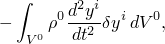
The terms in  can be identified as follows. The first term,
Writing the angular velocity of the rotating basis system as its components in that system,  , gives the second term as
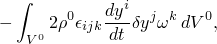
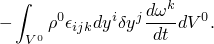
 is the alternator tensor. This term is the Coriolis force term and arises whenever there is velocity in the rotating system, which can happen in dynamic analysis or in quasi-static cases in which a constant velocity has been introduced (for example, by defining an initial velocity).
The third term is, likewise, rewritten as

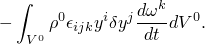
Similarly, the fourth term is rewritten as
In Abaqus/Standard the centrifugal load, Coriolis, and rotary acceleration terms contribute to the “load stiffness matrix.” The centrifugal load term has a symmetric load stiffness matrix,