


Products: Abaqus/Standard Abaqus/Explicit
Abaqus provides an isotropic hardening model that is useful for cases involving gross plastic straining or in cases where the straining at each point is essentially in the same direction in strain space throughout the analysis.
Although the model is referred to as a “hardening” model, strain softening or hardening followed by softening can be defined.
This material model is very commonly used for metal plasticity calculations, either as a rate-dependent or as a rate-independent model, and has a particularly simple form. Because of this simplicity the algebraic equations associated with integrating the model are easily developed in terms of a single variable, and the material stiffness matrix can be written explicitly. This results in particularly efficient code. In this section these equations are developed.
For simplicity of notation all quantities not explicitly associated with a time point are assumed to be evaluated at the end of the increment.
The Mises yield function with associated flow means that there is no volumetric plastic strain; since the elastic bulk modulus is quite large, the volume change will be small. Thus, we can define the volume strain as

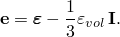
The strain rate decomposition is

The elasticity is linear and isotropic and, therefore, can be written in terms of two temperature-dependent material parameters. For the purpose of this development it is most appropriate to choose these parameters as the bulk modulus, K, and the shear modulus, G. These are computed readily from the user's input of Young's modulus, E, and Poisson's ratio,  , as
, as
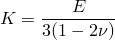
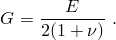
The elasticity can be written in volumetric and deviatoric components as follows.
Volumetric:
where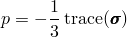
Deviatoric:
where is the deviatoric stress,
The flow rule is
where
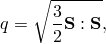
 is the (scalar) equivalent plastic strain rate.
The plasticity requires that the material satisfy a uniaxial-stress plastic-strain strain-rate relationship. If the material is rate independent, this is the yield condition:
where is the yield stress and is defined by the user as a function of equivalent plastic strain (
 ) and temperature (
 ).
).If the material is rate dependent, the relationship is the uniaxial flow rate definition:

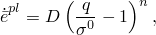
 and
and  are user-defined temperature-dependent material parameters and is the static yield stress.
Integrating this relationship by the backward Euler method gives
This equation can be inverted (numerically, if necessary) to give q as a function of at the end of the increment.
Thus, both the rate-independent model and the integrated rate-dependent model give the general uniaxial form
where for the rate-independent model and
  is obtained by inversion of Equation 4.3.2–6 for the rate-dependent model.
Equation 4.3.2–1 to Equation 4.3.2–7 define the material behavior. In any increment when plastic flow is occurring (which is determined by evaluating q based on purely elastic response and finding that its value exceeds  ), these equations must be integrated and solved for the state at the end of the increment. As in the general discussion in “Metal plasticity models,” Section 4.3.1, the integration is done by applying the backward Euler method to the flow rule (Equation 4.3.2–4), giving
Combining this with the deviatoric elasticity (Equation 4.3.2–3) and the integrated strain rate decomposition (Equation 4.3.2–1) gives
Using the integrated flow rule (Equation 4.3.2–8), together with the Mises definition of the flow direction,  (in Equation 4.3.2–4), this becomes

For simplicity of notation we write
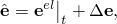
Taking the inner product of this equation with itself gives
where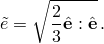
The Mises equivalent stress, q, must satisfy the uniaxial form defined in Equation 4.3.2–7, so that from Equation 4.3.2–11,
This is a nonlinear equation for  in the general case when depends on the equivalent plastic strain (that is, when the material is rate-dependent, or when there is nonzero work hardening). (It is linear in
  for rate-independent perfect plasticity.) We solve it by Newton's method:


Once  is known, the solution is fully defined: using Equation 4.3.2–5,

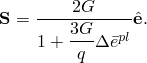


For cases where three direct strain components are provided by the kinematic solution (that is, all but plane stress and uniaxial stress cases), Equation 4.3.2–2 defines

For plane stress  is not defined by the kinematics but by the plane stress constraint

This additional equation (or equivalently  ) must be solved along with the yield condition and Equation 4.3.2–9. The predicted third strain component



 that enables (with the correct plastic straining) the plane stress condition to be satisfied.
For this simple plasticity model the material stiffness matrix can be derived without the need for matrix inversion (as was needed in the general case described in “Integration of plasticity models,” Section 4.2.2), as follows.
Taking the variation of Equation 4.3.2–10 with respect to all quantities at the end of the increment gives
Now, from Equation 4.3.2–5,


Combining these last two results,
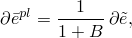

From the definition of  (see Equation 4.3.2–11),
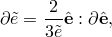
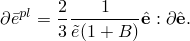
Combining these results with Equation 4.3.2–14 gives
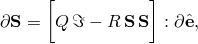
 ,
,  is the fourth-order unit tensor, and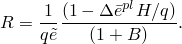
For all cases where three direct strains are defined by the kinematic solution, the material stiffness is completed by


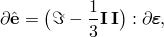

For the plane stress case the material stiffness matrix is found by imposing

For the uniaxial stress case the material stiffness matrix is available directly from the variation of Equation 4.3.2–13 as















