


Product: Abaqus/Standard
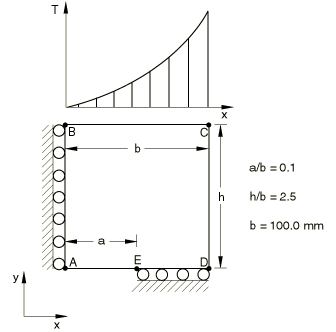
Mesh:
Collapsed elements with 1/4 point midside nodes are used at the crack tip. One-quarter of the test geometry is modeled.
Material:
Young's modulus = 207 GPa, Poisson's ratio = 0.3, thermal expansion coefficent = 1.35E–5.
Boundary conditions:
 along edge AB,
  along edge DE.
Loading:
Quadratic thermal distribution T = T0 = 0.01x2, where T0 = 100, c = 100.
This is a test recommended by the National Agency for Finite Element Methods and Standards (U.K.): Test 1.2 from NAFEMS publication “2D Test Cases in Linear Elastic Fracture Mechanics,” R0020.
Target solution: K /K
/K = 1.000, K =
The results are shown in the following table. The values enclosed in parentheses are percentage differences with respect to the reference solution.
K =  . An average of the J values calculated by Abaqus, excluding the first contour, is used in reporting the results. Experience has shown that the crack-tip elements do not give sufficiently accurate results to give good estimates of the J-integral for the first contour. The thermal loading is applied with user subroutine UTEMP.
CPS8 elements.
User subroutine UTEMP used in nlf12f8x.inp.
CPS8R elements.
User subroutine UTEMP used in nlf12r8x.inp.